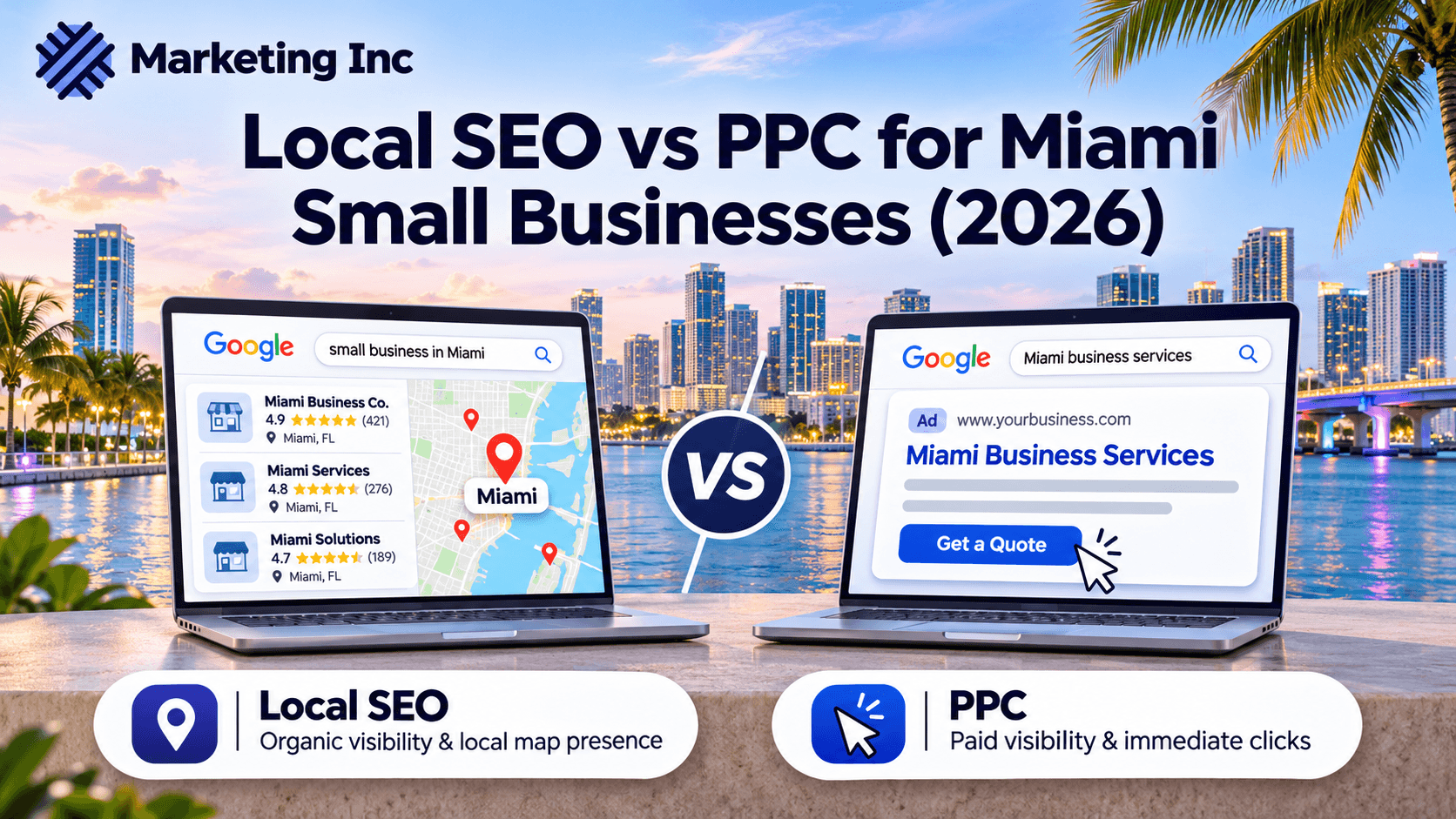
Local SEO vs PPC for Miami Small Businesses (2026)
Discover local SEO vs PPC for Miami small businesses in 2026. Learn how to attract bilingual customers, improve Google visibility, and generate leads.
Local SEO builds lasting search visibility for Miami businesses over months, while PPC advertising can bring relevant leads sooner. Most Miami-Dade service companies should use both initially, then shift more budget toward SEO as organic rankings and inquiries improve. Because customers search in English and Spanish across different neighborhoods, accurate Google Business Profiles, genuine reviews, and clear service-area pages also help Google and AI assistants understand your business.
A dentist in Coral Gables, a home-services company in Hialeah, and a restaurant in Miami Beach do not compete for the same customer. Even within Miami, someone looking for a lawyer near Brickell has different expectations from a resident searching for an emergency plumber in Doral. Yet all these businesses face the same marketing decision: should you invest in local SEO, pay-per-click advertising (PPC), or both?
The best answer depends on how urgently you need inquiries, which neighborhoods you serve, and whether customers search in English, Spanish, or both. Here is a practical way to choose without paying for irrelevant traffic or creating pages that do not help readers.
SEO vs PPC for Miami Small Businesses: One Simple Comparison
Local search engine optimization helps eligible businesses appear in unpaid Google results and Maps by improving their websites, business information, content, and reputation. PPC lets businesses run paid search advertisements associated with targeted queries. Unlike organic listings, paid placements require ongoing ad spend. Neither channel guarantees calls, appointments, or revenue; your offer and customer experience still matter.
| Factor | Local SEO | PPC Advertising |
|---|---|---|
| Cost pattern | Ongoing effort for profiles, content, website maintenance, and optimization | Advertising spend plus ongoing campaign management |
| Time to results | Gradual improvement over months | Traffic can begin soon after ads are approved and active |
| Best for | Building long-term discovery, local trust, and steady inquiries | Launches, urgent services, limited-time campaigns, and immediate demand |
| Main risk | Rankings fluctuate and progress is not guaranteed | Irrelevant clicks consume budget; traffic may stop when ads pause |
For a new clinic in Doral, paid ads may help people discover available appointments while the business builds its local presence. An established Coral Gables practice may already attract organic inquiries and use PPC only for particular services. Often the strongest approach is to build the SEO foundation immediately, advertise selectively, and revisit the mix once you can measure qualified leads.
For the broader decision, see our SEO vs PPC guide for Florida businesses.
What Miami Searches Really Look Like: Neighborhoods, Languages, and Visitors
“Near me” rarely means all of Miami
Miami-Dade is a collection of distinct service markets, not one uniform search location. Someone searching “dentist near me” in Brickell is likely to see different local options than someone making the same search in Hialeah. Likewise, a Doral business may serve nearby offices and households without offering appointments in Miami Beach.
Google explains that local results depend mainly on relevance, distance, and prominence. A business cannot simply declare that it wants to rank everywhere in the county. Its real location, service coverage, and reputation help determine where it may appear. Read Google’s guidance on local ranking.
Consider how intent changes by area:
-
Brickell: a search for a dentist or law office may prioritize convenient appointments, contact details, and access from nearby workplaces.
-
Coral Gables: a family searching for a clinic may compare services, office location, hours, and patient information.
-
Hialeah: a homeowner searching for AC repair might use either English or Spanish and expect clear information about availability.
-
Doral: a commercial customer may look for contractors or professional services that cover its specific business location.
-
Miami Beach: a restaurant search may come from a tourist, hotel guest, resident, or employee, each with different practical needs.
English and Spanish are not interchangeable keywords
Miami businesses have an opportunity to serve customers who naturally search in either language. Someone may type “emergency dentist Miami” while another searches “dentista de emergencia en Miami.” Those queries express similar needs, but the landing experience should match what the business can actually deliver.
If your team can serve customers in Spanish, write useful Spanish-language explanations of services, appointment steps, and contact options. Have a fluent speaker review terminology, especially for medical, legal, or technical services. Do not translate a few keywords into Spanish while leaving the rest of the booking process inaccessible. If you publish genuine English and Spanish versions of the same content at separate URLs, follow Google’s guidance for multilingual websites.
Tourism and seasonal demand can change the audience
Miami Beach hospitality and restaurant searches can attract visitors who want an immediate answer, while a local homeowner might research a service provider before booking. Events, holiday travel, and seasonal changes can influence demand, especially for food, hospitality, transportation, and beauty services. Home-service businesses may also experience urgent requests related to storms or equipment failures.
A smart campaign separates resident needs from visitor needs instead of assuming every Miami searcher has the same intent. Before expanding coverage, ask whether you can actually deliver the advertised service in that area and language.
Local SEO Checklist for Miami-Dade Service Businesses
Keep your Google Business Profile accurate
Complete your profile with the business name you use in the real world, an accurate category, website, phone number, hours, and services. Add genuine photos that help customers understand the premises, staff, or work performed. If you travel to customers instead of receiving them at an office, use the appropriate service-area configuration rather than claiming fictional branches in Brickell, Miami Beach, or Doral.
A complete profile can help customers decide whether to call. A wrong phone number, outdated hours, or a listing that suggests an office where none exists can undermine both visibility and trust. Google outlines these expectations in its Business Profile representation guidelines.
Encourage authentic reviews in the customer’s preferred language
Ask customers for honest feedback after a real interaction. If Spanish-speaking customers choose to leave reviews in Spanish, those reviews can be helpful to others who speak that language. Respond courteously in a language your staff can use accurately, and address concerns without revealing private customer details.
Do not purchase reviews, reward people for positive ratings, or pressure customers to use specific wording. Google’s review guidelines prohibit incentivized or misleading reviews. The goal is credible evidence of a genuine customer experience, not a manufactured score.
Build useful service pages, then add genuine area detail
Begin with substantive pages for services customers actually seek: dental cleanings, family-law consultations, drain repairs, medical appointments, or restaurant reservations. Explain the service, what customers should expect, who it is for, and how to contact you.
Area pages can help when they serve a real purpose. A contractor who visits both Hialeah and Doral might explain service availability, scheduling constraints, and local coverage on separate useful pages. A Coral Gables office should not publish nearly identical “Miami Beach office” and “Brickell office” pages if those offices do not exist. Avoid copying paragraphs and replacing neighborhood names.
For more ideas on site structure and organic performance, read our 10 proven SEO strategies for Florida businesses. For another Florida market comparison, see our Sarasota small-business SEO vs PPC guide.
Check NAP consistency and the mobile experience
NAP means name, address, and phone number. Keep these details consistent across the website and legitimate directories, with appropriate privacy settings for service-area businesses. Correct disconnected numbers and outdated business listings. Make service pages easy to read on phones, with clear appointment, call, directions, or booking actions.
Track whether people actually contact you. Rankings and website visits matter less if prospective customers cannot find an accessible form or reach someone who answers their questions.
Check how visible your business is to Google and AI assistants with the free GEO audit.
When PPC Wins in Miami—and How to Avoid Waste
Use paid search when speed or timing matters
PPC can be especially useful for a new location, a seasonal promotion, an event-driven restaurant campaign, or an urgent home service. A Miami Beach restaurant may want to reach nearby people looking for dinner today. A Doral contractor may advertise a specific repair service when technicians have capacity. A newly opened clinic may use ads while its organic presence develops.
The benefit is the ability to focus campaigns on particular services and search intent. But advertising should point to a page that genuinely answers the search. An ad promising a bilingual consultation should lead to clear scheduling information and support in that language, not a generic homepage.
Separate local prospects from irrelevant traffic
A Miami business should examine its geographic targeting carefully. Searchers interested in Miami are not necessarily physically located there; that distinction matters for same-day appointments and emergency work. Google Ads describes how its location targeting settings can include people in or interested in selected places. Review Google’s location-targeting guidance and select settings that suit your business.
Compare lead quality from Brickell, Hialeah, Doral, Coral Gables, and Miami Beach rather than lumping every inquiry into “Miami.” If your staff cannot serve a particular location, exclude it. If you run Spanish-language ads, confirm the ad, landing page, and customer support actually work for Spanish-speaking leads.
Watch the common PPC mistakes
Businesses seeking PPC management in Miami, FL should ask how campaigns track qualified phone calls, form submissions, and appointments. Common mistakes include broad keywords with weak intent, missing negative keywords, poor location settings, generic landing pages, and ads running when no one is available to respond.
A click is not a booking. Review search terms and actual outcomes regularly, then adjust targeting and messaging. Our article on common PPC mistakes that waste your ad budget covers the most important issues in more detail.
How Miami Businesses Can Get Found by ChatGPT and Google AI Overviews
Customers may now ask, “Which dentists in Coral Gables offer appointments in Spanish?” or “What reliable AC companies serve Hialeah?” AI-powered experiences can summarize available information, but the exact sources and selection process vary by platform and query. No business can guarantee it will appear in an AI recommendation.
The practical foundation overlaps with local SEO: accurate business information, clear descriptions of services and locations, credible reviews, helpful pages, and a website accessible to search tools. Google says conventional SEO practices remain relevant to its AI features; see Google Search Central’s AI features guidance.
Make specific questions easy to answer
A bilingual clinic could explain which services are offered in Spanish and how to request an appointment. A restaurant might publish accurate hours, menus, reservation information, and neighborhood location details. A contractor could list the exact areas served and whether emergency assistance is available. Such details help people make decisions regardless of whether they arrive through Google Maps, traditional search, paid ads, or an AI answer.
Avoid statements like “the best dentist in Miami” without evidence. Instead, provide verifiable facts: what services you offer, where customers can find you, and how they can get help. Answer FAQs in clear language, but do not assume FAQ markup alone will trigger AI mentions.
Measure visibility alongside real inquiries
Test realistic English and Spanish questions in relevant AI tools and record whether your business is mentioned and which sources appear. Treat each result as a snapshot rather than a permanent ranking. Compare those observations with organic search inquiries, profile interactions, paid conversions, and completed bookings.
A free GEO audit can help identify website content and technical readiness issues. It is a useful diagnostic, not a promise of inclusion in ChatGPT or Google AI Overviews. If you also serve Tampa Bay, our Tampa local SEO vs PPC guide explains why that market calls for different geographic planning.
For another regional comparison, explore our Orlando local SEO vs PPC guide, which explains how Central Florida businesses balance local customer searches, visitor demand, and paid advertising.
Frequently Asked Questions About SEO vs PPC in Miami
Is SEO or PPC better for a new Miami business?
PPC can generate inquiries sooner, while local SEO builds visibility over time. New Miami businesses can use both and adjust their budget as organic rankings and qualified leads improve. Start with an accurate business profile, useful service pages, and advertising targeted to customers you can actually serve.
How long does local SEO take in Miami?
Local SEO generally takes several months to produce meaningful results. The timeline depends on competition, website quality, Google Business Profile accuracy, and ongoing optimization. Correcting inaccurate business details can happen quickly, but stronger rankings and regular inquiries usually require sustained work.
Do I need separate pages for Miami, Miami Beach and Coral Gables?
Create separate pages only for areas your business actually serves. Each page should provide unique service information rather than copying the same content with different city names. Explain relevant availability, location details, and customer questions without inventing physical offices.
Should I target Spanish-language searches?
Yes, if your business genuinely serves Spanish-speaking customers. Create accurate, useful Spanish-language content and advertise services your team can deliver in Spanish. Match the language of your landing page, forms, and customer support to what your ads promise.
Do AI assistants use Google reviews?
Some AI-powered search experiences may use public reviews and business listings. Genuine reviews can support credibility, but they do not guarantee that an AI assistant will recommend your business. How reviews are incorporated depends on the particular system and sources available.
Can I run SEO and PPC together?
Yes. PPC can provide immediate visibility while SEO builds long-term organic traffic. Monitor conversions and lead quality to decide how to distribute your marketing budget. As organic inquiries become more dependable, you can adjust paid campaigns toward services that still need extra visibility.
The right decision for a Miami small business is rarely SEO instead of PPC. Build trustworthy local visibility, advertise when the timing and audience make sense, and communicate clearly in the languages and neighborhoods you truly serve.
Check how visible your business is to Google and AI assistants with the free GEO audit.